

Foamit’s Environmental Product Declaration (EPD)
Foamit Group’s subsidiary Uusioaines has completed the company’s first internally prepared and third-party verified Environmental Product Declaration (EPD) for foam glass aggregate produced at its Forssa plant. This means that customers now have access to the most up-to-date, independently verified emissions calculation for Foamit’s foam glass aggregate, based on 2024 data.
The EPD has been prepared for foam glass aggregate supplied from the Forssa plant in bulk and in big bags.
The new EPD provides a more comprehensive view of the product’s entire supply chain. For the first time, the calculation also includes transportation from production to the construction site (module A4) and installation of the product at the construction site (A5). This makes the EPD significantly easier to use as part of the overall emissions assessment of construction projects.
Carbon dioxide emissions from production have decreased in the new calculation. Emissions from the manufacturing stage (A1–A3, i.e. raw material sourcing, transport, and production) have been reduced by 18% compared to the previous Environmental Product Declaration.
Ask our experts

Emily Lainpelto
HSEQ Manager
Occupational health and safety, the environment, and quality
Tel. +35840 936 463 8
emily.lainpelto[a]uusioaines.com
Foamit’s carbon footprint
Foamit’s life cycle carbon footprint is a calculated average of
Foamit Group’s four production plants in
Finland, Sweden and Norway.

Uusioaines Forssa, Finland (A1-A3)
46,3 kg CO2 eq. / m3
Glasopor Skjåk, Norway
12,90 kg CO2 eq. / m3
Glasopor Onsøy, Norway
46,51 kg CO2 eq. / m3
Hasopor Hammar, Sweden (A1-A3)
8,6 kg CO2 eq. / m3
An EPD is an objective statement of the environmental impact of a product
EPD is internationally standardized, and a trustworthy way to gather and share information about a product’s environmental effects throughout its life cycle. The EPD document is produced transparently and third-party verified. It contains researched, accurate and comparable data on emissions, resource use and environmental impacts.
The EPD is based on a life cycle assessment (LCA), which identifies the biggest environmental impacts of a product’s materials and processes. Foamit Group also uses life cycle analysis as a basis for prioritizing product and process development measures.
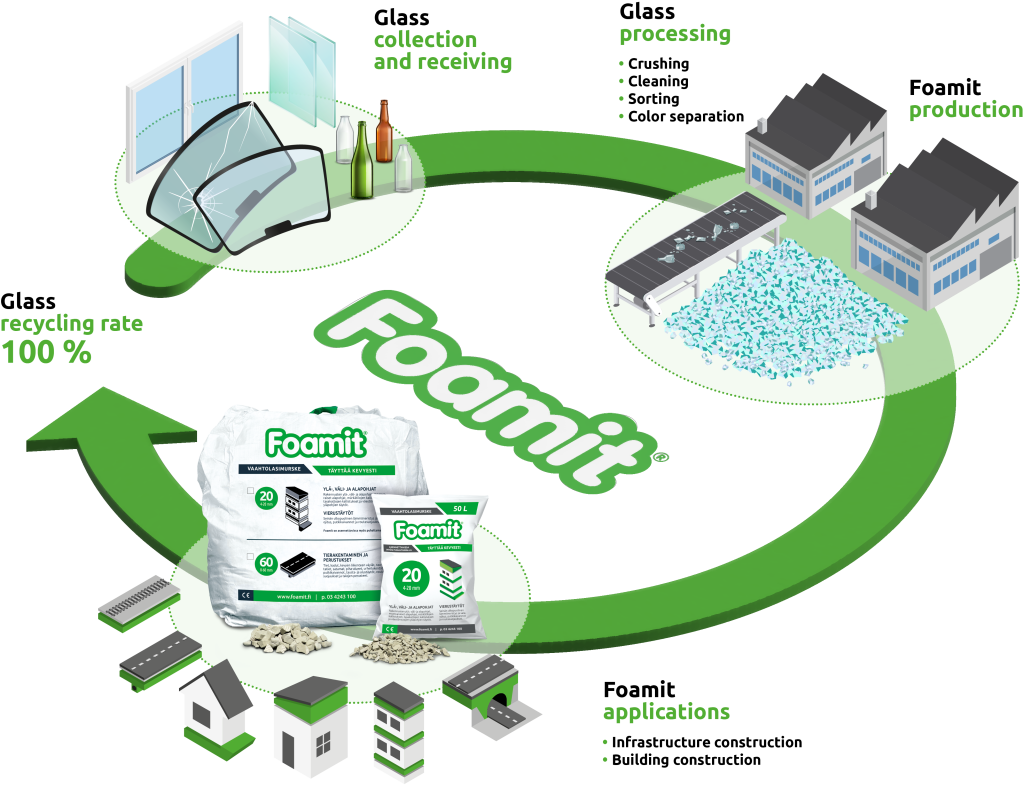
Life cycle analysis is guided by Product Category Rules (PCR), which define, for example, which life cycle stages should be taken into account in the analysis. Foamit’s EPD includes the following modules:
A1: Raw material supply
A2: Transport of the raw materials
A3: Manufacturing of foam glass aggregate
C1–C4: End of life stage
D: Benefits and loads beyond the system boundary
The EPD is in effect for five years and is publicly visible, as well as downloadable, from a global registry maintained by the EPD organization Environdec. You can find a wealth of related information and materials from its website, including answers to frequently asked questions concerning EPD.
 Contact us