

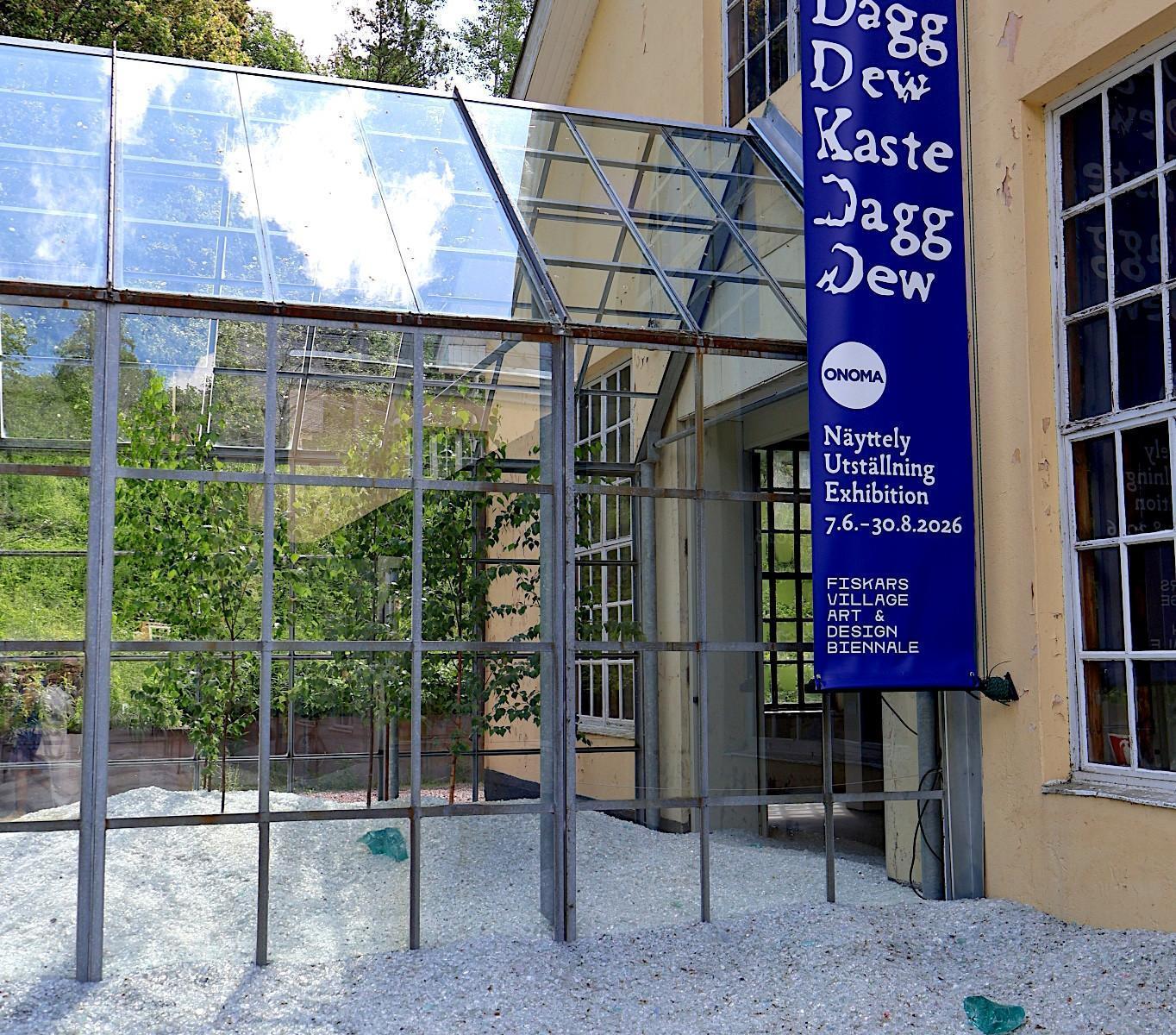
Finnish architect Marco Casagrande would rather build in a way that lets nature serve as co-designer. Most of today’s construction, he argues, is an industrial illusion. Recycled glass aggregate from Foamit plays a prominent role in the summer exhibition of Onoma, the Fiskars cooperative of artisans, designers and artists in Finland, with Casagrande as both curator and exhibition architect.
Marco Casagrande is one of Finland’s best-known contemporary architects and environmental artists. He has shown his work at the Venice Architecture Biennale several times, taught and built across Europe, Asia and North America, and held a professorship at the Bergen School of Architecture in Norway, among others. He currently holds two professorships in architecture in Ukraine. In 2015 he received the international Global Award for Sustainable Architecture from UNESCO and the Locus Foundation. The Kaste/Dagg/Dew exhibition in Fiskars brings him close to home: based in Karis, Finland, Casagrande visits the Fiskars ironworks village weekly and knows the place and its community of artists intimately.
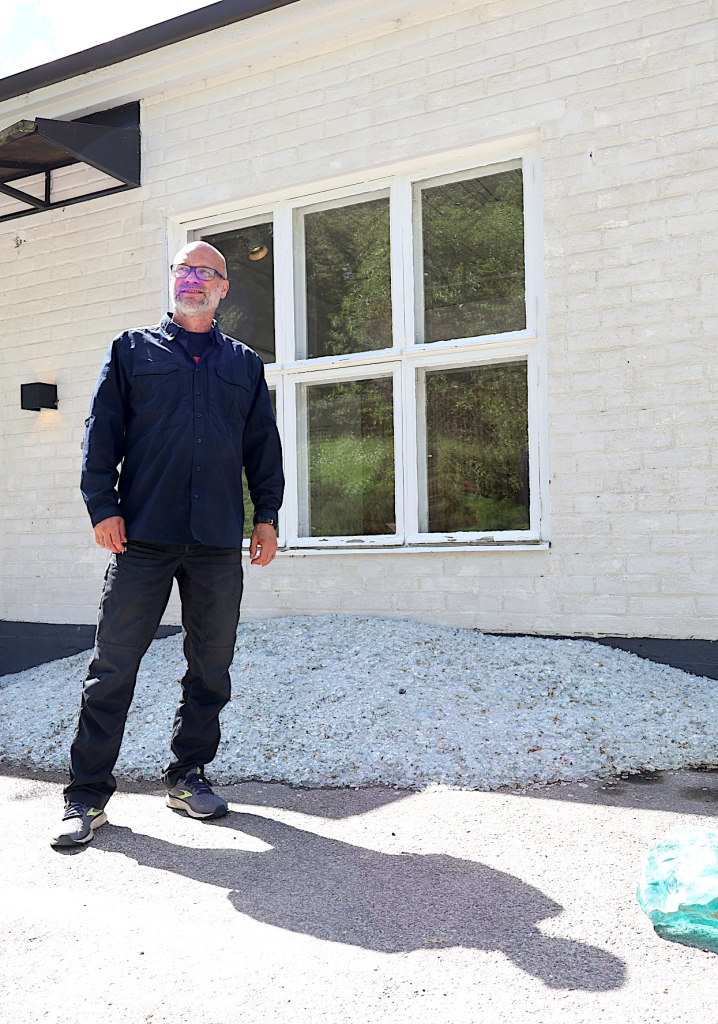
Marco Casagrande, architect and environmental artists
There is no reality other than nature
It doesn’t take long to steer Casagrande toward the big questions. “Most of the construction work is actually pollution. We imagine we have no choice but to do it this way, but that’s an illusion that industry sells us,” he says. It’s a striking claim from an architect, yet it rests on a consistent line of thought that comes down to a single idea: there is no reality other than nature. For Casagrande, that means nature should be brought into building as a partner — a co-designer — rather than treated as an obstacle to build against. In every project he looks for local knowledge: the centuries-old human skill of adapting to one particular place.
So what does nature mean to someone who works with concrete, steel and glass? For Casagrande, it comes down to the role of a building. Too often a building is seen as a shelter that shuts nature out. “People tend to think of a building as a lump of concrete with a person inside it,” he says. “I think of a building as a mediator. Of course it offers shelter, but at the same time it connects the person inside to the nature around them.”
Glass has many lives
His thinking comes to a head in materials. Casagrande has long wished that more construction work in Finland were done in wood, since the raw material grows practically next door. Even so, he doesn’t reject industrial materials outright — what matters is whether a material keeps circulating or ends its life after a single use. That is exactly why he wanted some 30,000 kilos of recycled glass aggregate from Foamit placed at the heart of the Kaste/Dagg/Dew exhibition, right alongside the works. It doesn’t recede into the background; it lifts the artworks into view. And it captures his thinking about the circular economy: recycled glass, he says, holds a kind of purity, the same presence as a skillfully blown glass object.
“Crushed glass is the most consoling industrial product I know,” he says. Casagrande likens the cycle of glass to the water cycle: from river to ice, to sea, and back to meltwater. Add energy to sand and a transparent surface forms — like frozen plasma. Crush the glass and the energy is released, and the material is ready once again to continue its cycle. Glass is one of the few industrial products you can recycle practically endlessly, and it’s that hundred-percent circularity that makes it feel so natural to him.
So where is the building industry headed? Casagrande believes that centralized infrastructure — energy, water, all of it — will gradually break down, because it simply isn’t sustainable. When it does, responsibility will return closer to people themselves. “Then we’ll start taking better care of the environment and the built environment around us.”
Materials always get a new life in Fiskars
Circular thinking has a permanent home in Fiskars, Finland. Led by Onoma, the village’s cooperative of artisans, designers and artists, the local artist community has built its life around reuse for three decades now. The summer 2026 exhibition Kaste/Dagg/Dew, too, puts waste to good use.
In the southern Finnish village of Fiskars, recycling is part of everyday life. “We believe in not wasting things, but making use of everything we possibly can,” says Matleena Kalajoki, executive director of Onoma, the cooperative behind the exhibition.
In practice, that means many of the artists use offcut timber from small-scale industry, share machines and workshop space with their neighbours, and draw their materials from the surrounding nature. The same thinking guides how Onoma builds its exhibitions: some of the partition walls and plinths are decades old, Kalajoki says, and travel from one show to the next. Logistics and everything else are kept local. “We do everything we can locally, to keep our carbon footprint as small as possible,” she says.
This way of thinking grows out of the village’s own history. Fiskars was, in a sense, reborn in the early 1990s, when industrial production moved elsewhere. “The buildings have been given a new life, and many artists have found a home and a workshop in these old industrial spaces,” Kalajoki says. The cooperative, founded around the same time, has spent more than 30 years making the ironworks village known as a hub of craft, design and art. Without that fresh start, she says, the village would be nowhere near as appealing as it is today. For many in the community, nature is also the reason to live in Fiskars: alongside peace and quiet, it offers inspiration and raw materials.
The Fiskars Village Art & Design Biennale is now in its fourth edition. Founded by Kari Korkman, CEO of Luovi Productions, it has been produced in partnership with Onoma from the start. This summer the biennale turns to water and the water cycle. The theme was an easy choice, according to Kalajoki — the village itself grew up on the banks of a river, and that waterway once linked it all the way to the Hanseatic towns of Europe. “Water felt completely natural and, at the same time, terribly topical. It’s not something we can take for granted,” Kalajoki says.
In the Kaste/Dagg/Dew exhibition, water is present in a surprising variety of ways — without a single drop of it. On display are mosses that live with water, ceramics and wood worked with the help of water, and music recorded underwater, among other things. “I would never have believed how many ways there are to depict water without water,” Kalajoki says.
The exhibition’s architecture and curation are the work of architect Marco Casagrande. His strong connection to nature, Kalajoki says, made him exactly the right person for a theme built around water. Recycled glass aggregate from Foamit fits the same story: it plays a prominent role in the Kaste exhibition, recycled glass given a new kind of life by lifting the artworks into view.
The Fiskars summer exhibition Kaste / Dagg / Dew is open at the Copper Smithy until 30 August 2026: https://onoma.fi/kaste-dagg-dew/.
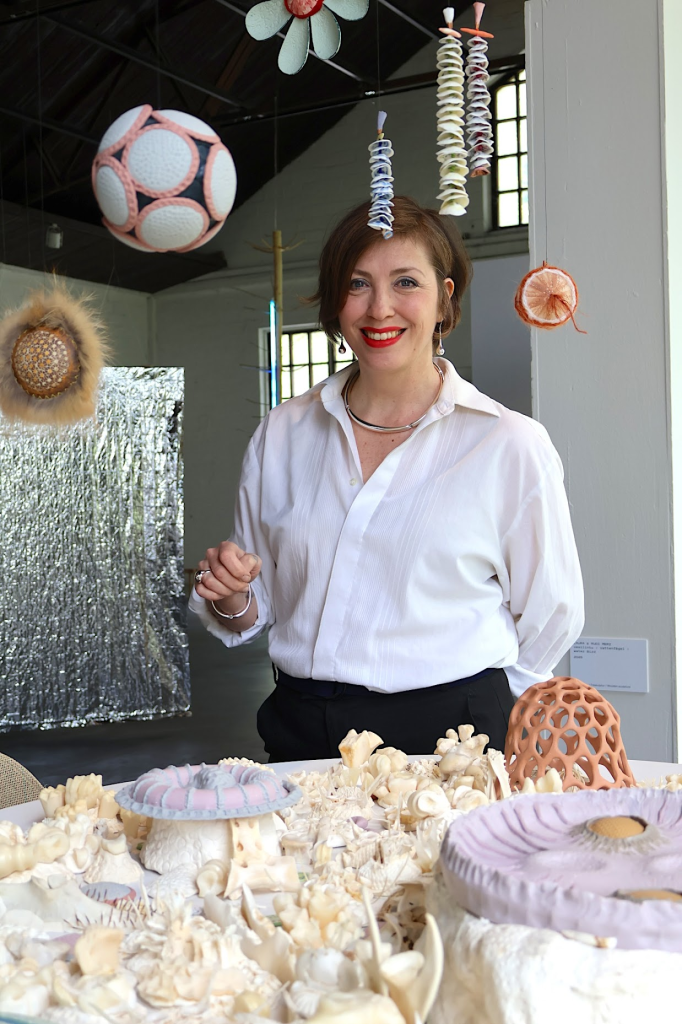
Matleena Kalajoki, Executive Director of Onoma
 Contact us